
Structural Drying & Water Mitigation in Bend, OR
Extraction gets the puddle. Structural drying gets the water out of framing, subfloor and wall cavities before it causes rot and mold. Independent Bend water mitigation companies quote the full dry-out for free.
Get a Free Quote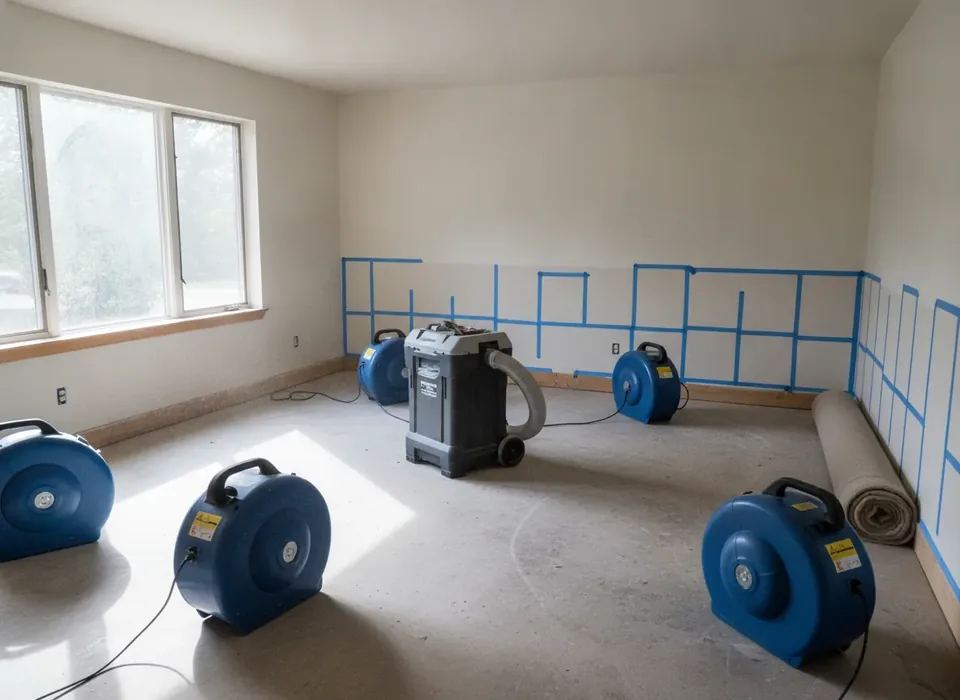
Dry to the touch is not dry
After the standing water is gone, a floor can look finished within hours in Bend's thin, dry air. Under it, the subfloor is still holding water, the bottom plate of the wall is wet, and the insulation in the cavity is a sponge. Structural drying is the measured, monitored process of bringing all of that back to normal moisture content, and it is the part of a water job that decides whether you get mold, cupped hardwood and a musty smell six months later.
What you can do before the crew arrives: keep the heat on, open interior doors, run bathroom fans, and do not pile wet material in one spot.
Send the quote form or call Call (727) 300-6656 and independent, Oregon CCB-licensed water mitigation companies serving Central Oregon can reply with free quotes. Bend Water Damage Pros does not perform drying; we connect you with the companies that do.
How professional structural drying works
This is the technical core of any water job, and the part adjusters scrutinise most closely.
Moisture mapping
Pin and pinless meters, and usually a thermal imaging camera, find every wet surface, including ones that look fine. The technician marks the wet boundary on walls and floors and records baseline readings against a dry reference area in the same house.
Extraction and removal
Remaining water is extracted. Materials that will not dry fast enough to beat mold, or that lose their integrity when wet (pad, particleboard, some insulation), come out. Asbestos survey rules for pre-2004 homes apply here.
Equipment placement
Air movers create fast airflow across wet surfaces to lift moisture into the air; low-grain refrigerant dehumidifiers pull it back out so the air can keep absorbing. Specialty gear, such as mat systems for hardwood or injection drying under cabinets, targets cavities that fans cannot reach. In winter, heat may be added because cold air dries slowly.
Daily monitoring
Technicians return each day, record temperature, humidity and material moisture readings, and reposition or remove equipment. The log should show steady progress toward the drying goal.
Verification and hand-off
When readings match the dry reference, equipment comes out and the file goes to your insurer. Rebuild begins.
Drying in the high desert
Bend averages roughly 10 to 11 inches of precipitation a year, and summer relative humidity regularly drops into the twenties and thirties. For drying, that is good news: dehumidifiers do not have to fight humid outside air, and the back half of a drying job tends to go faster here than in the Willamette Valley.
Winter is a different story. Cold air holds very little moisture, so opening a window in January does nothing useful, and a crawl space sitting at 40°F evaporates water slowly no matter how many fans are running. Expect winter losses, which are also the most common ones here thanks to frozen pipes and ice dams, to need heat drying or longer schedules. Our post on how long drying takes in Central Oregon gives typical timelines by season and material.
Flooring matters as much as climate. Many Bend homes built since 2000 have engineered or solid hardwood on the main level; hardwood can often be saved with mat drying if it is started within a day or two, and replaced at $10–$15 per square foot if it is not. Read can hardwood floors be saved before you decide.
Contents pack-out
When a loss covers several rooms, drying goes faster with the furniture out of the way. A contents pack-out means the company inventories and photographs your belongings, cleans what is salvageable, and stores it until the rebuild is done. Under Oregon's restoration-contractor rules, personal property inventory after a sudden loss is part of licensed restoration work. The inventory is also your contents claim, so ask for a copy.
What structural drying typically costs
Drying is priced by the class of loss, which reflects how much wet material and how hard it is to dry. Class 1 (a small area, little absorption) typically runs $150–$400; Class 2 (a full room with wet walls to a foot or two) $500–$1,000; Class 3 (water from above, ceilings and walls saturated) $1,000–$3,000; Class 4 (hardwood, plaster, concrete, deep saturation) $20,000 and up. Labor is billed at about $70–$200 per hour, and equipment is billed per unit per day; ask for the line items rather than a lump sum so you can compare quotes.
Typical ranges, national sources, Jan–2025 data; Central Oregon quotes vary. Your written quote is the real number.
The cost guide explains class versus category and includes a calculator for planning.
Insurance and the drying log
Insurers and restoration companies price mitigation with Xactimate line items: so many air movers for so many days, so many square feet of extraction. Your adjuster will want the moisture map, the daily log and photos. A company that documents well makes your claim easier; one that does not can leave you arguing over equipment days. You are entitled under ORS 746.230 to prompt, reasonable handling of the claim, and you do not have to sign an assignment of benefits for the drying to start, whatever a form may imply.
Get drying started fast when
- Hardwood or engineered flooring is wet; the save-or-replace window is short.
- Water went through a ceiling or down an interior wall.
- Cabinets, built-ins or a tiled shower surround are involved; cavities behind them trap water.
- More than about 48 hours have passed since the water arrived.
- The loss is in a crawl space or an unheated space in winter.
The process page shows where drying sits in the overall timeline, from first call to rebuild.
Structural drying FAQ
How long does structural drying take in Bend?
Three to five days is typical for a clean-water loss caught early; a week or more for saturated hardwood, plaster, concrete or a cold crawl space. Bend's dry air shortens the tail end of the job once equipment is running, but it does not change the first 48 hours. The company should state a drying goal and show daily readings until it is met.
Can I turn the equipment off at night?
Better not. Drying is cumulative, and every hour the fans and dehumidifier are off, moisture in the wall cavity equalises back toward the surface. The equipment is loud and the power draw is real, but switching it off usually adds days. If noise is unbearable, ask the technician whether a room can be sealed off or a quieter unit substituted.
Why do they need so many air movers?
Evaporation happens at the surface, and each air mover only pushes a fast, dry layer across a limited stretch of wall or floor. The IICRC S500 standard gives placement guidelines based on the square footage and the linear feet of wet wall. Too few units means dry drywall on the outside and wet framing behind it. Ask the technician to explain the count; a good one will.
What is the difference between water mitigation and restoration?
Mitigation is everything that stops the damage from getting worse: extraction, removal of unsalvageable material, drying and documentation. Restoration or rebuild is putting the house back: drywall, paint, flooring, trim. In Oregon, mitigation after a sudden loss falls under the CCB's Residential Restoration endorsement, while tear-out and rebuild need a general or specialty endorsement. Some companies do both; some hand off.
Do my belongings have to leave the house?
Not always. For a one-room loss, furniture is usually moved and blocked up, and the room is dried around it. For larger losses, a contents pack-out is common: items are inventoried, photographed, cleaned where needed and stored until the rebuild is done. The inventory doubles as your claim documentation. Ask whether pack-out is in the quote or billed separately.
Get free quotes from Central Oregon restoration companies
Tell the companies which materials are wet, when the water arrived and whether extraction has already been done. Independent Central Oregon water mitigation companies reply with free quotes.
Water where it shouldn't be? Get free quotes.
Tell us what happened and independent Central Oregon restoration companies can reply with no-obligation quotes.